The technical experience must remain invisible.
21. Mai 2025
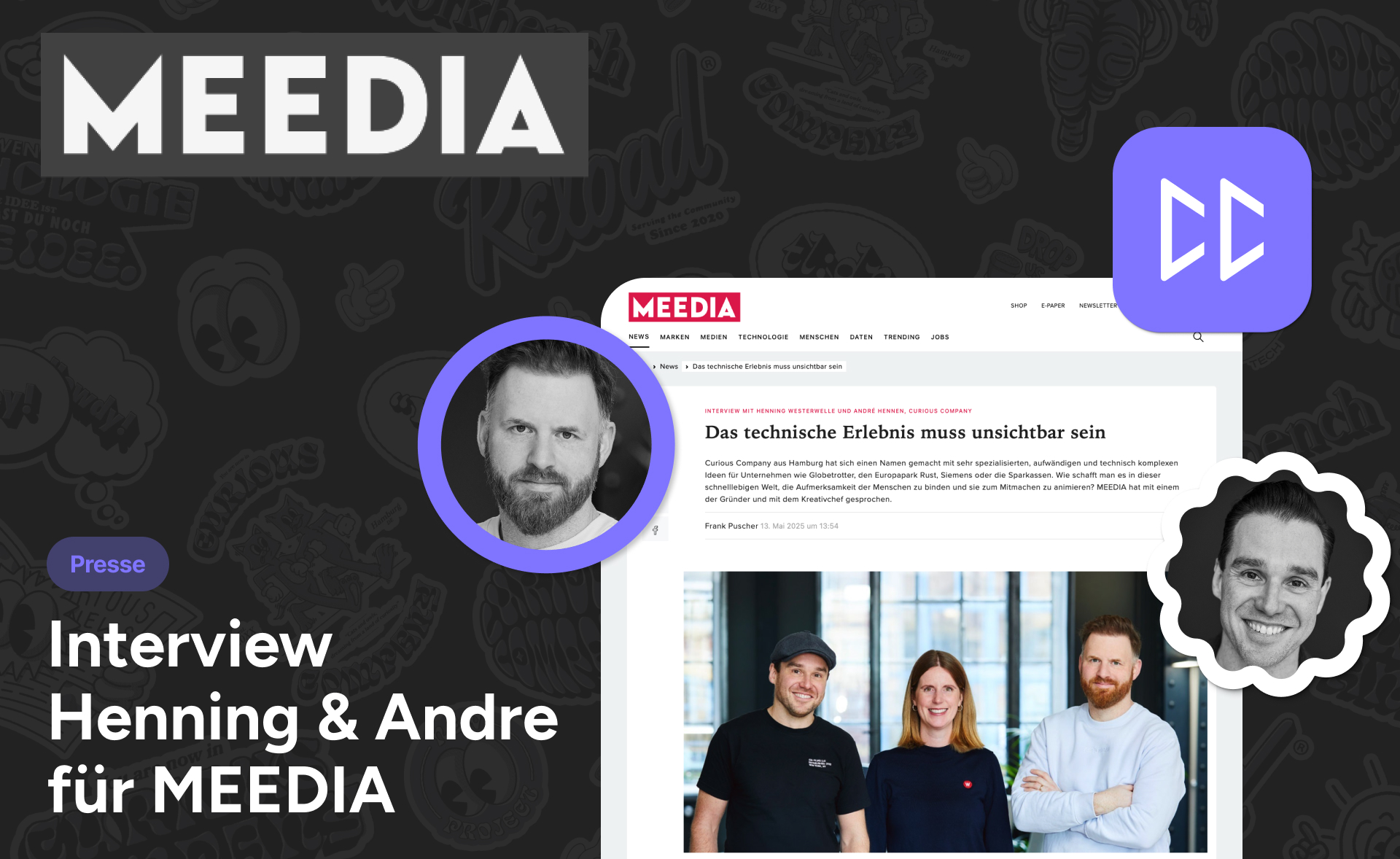
Link to the article at MEEDIA
Curious Company from Hamburg has made a name for itself with highly specialized, elaborate, and technically complex ideas for companies like Globetrotter, Europa-Park Rust, Siemens, and the Sparkassen. How do you manage to capture people’s attention and get them to participate in such a fast-paced world? MEEDIA spoke with one of the founders and the creative director.
Globetrotter fans were allowed to virtually climb mountains in the Hamburg Europapassage (MEEDIA reported). Sparkassen customers were asked to interact with an aged version of themselves. Siemens employees were immersed in a kind of corporate metaverse, engaging with the everyday problems of potential customers to learn how the company can help.
Behind all these projects is Curious Company. The Hamburg agency specializes in technology-based storytelling. Beyond its unique standing in the industry, this also brings challenges. No client wants to simply take over a predecessor’s project and slap their logo on it. Technical know-how acquired at Curious Company and hardware purchased often only function in a single project.
MEEDIA spoke with one of the founders, Henning Westerwelle, and the creative director, André Hennen, about how this works.
Mr. Westerwelle, these are very turbulent times. How does Curious Company deal with it?
Westerwelle: During 2023, we focused heavily on specialization. Our USP is our understanding of holistic, including digital, communication consulting and production. We divide this into three areas that we focus on.
These are: Business, Storytelling, and Technology, or Business Story Tech. We see it as a cycle. Nothing works without the other. Even strong storytelling and creative skills only work if we first clearly define strategic and business goals with our clients, and then leverage strong storytelling and relevant, new, well-selected technology to implement productions, products, and campaigns. The goals we set upfront are later reviewed. We then offer adjustments, interactions, versioning, and further development.
We realized that bringing products to market and developing products for our clients that remain alive and on-site has actually become a USP of our work. Nothing is launched online just to be shut down after a two-month campaign period.
Hennen: We actually work without campaigns. And if we do, we only invite people into „digital marketing products“ that work in the long term. We call this principle digital sustainability. It also breaks up some silos in the industry: previously there were creative agencies with storytelling, consultancies with business strategy, and digital productions focused on technology. And they would constantly criticize each other in trade media („your funny little videos don’t work without strategy,“ etc.). Fortunately, those times are over: Business, Story, and Tech are equally important – then you create sustainable impact. Even in marketing.
Can this universalism concept be seen as a trend in the agency landscape?
Hennen: By now, even the last person has noticed. Almost every classic storytelling agency is now part of a network. You have to work in a different business context than before. And I say this as a creative, which is already weird enough. Every area needs appreciation for the other two areas.
How does that manifest?
Hennen: We approach all areas so that things last a long time: this is also good for the story. If you have a good storytelling hook, it should continue. A good book doesn’t end after three weeks of a campaign period.
Westerwelle: Previously, there was a binary view that something was either performance-based or programmatically served, or it was brand-focused, pursuing a bigger goal and winning a creative award. Interestingly, we were always the ones who said the path lies in the gray area in between.
Can clients handle such a paradigm shift? Even there, the brand-performance dichotomy is reflected.
Westerwelle: In the end, it requires clients who not only want to stand out but also bring a tangible business problem. The door doesn’t open anymore just because someone brings some technology. The Apple Vision Pro doesn’t open new business doors.
Hennen: Older readers might remember: Sebastian Turner tried for 30 years to prove that creation works. And by now, it does. After production, we also continuously track how our creation is used and how it converts. For this, we developed our own analytics platform, Curio.OS. I would argue we are the only ones who built something like this.
Where did the idea to build it come from?
Hennen: The desire originally came from the storytelling side. We wanted to know how long people stay in the story. Then the clients said, „That’s really interesting, we want that too.“
We also had the moment with a campaign that was supposed to be shut down reflexively after a few months. Then we could show: the thing is still used all the time, contracts are constantly being signed. So the project was not shut down.
With the Globetrotter VR experience project in 2019, it was difficult to find a new company to use such a new setup. Are clients open to these discussions?
Westerwelle: Globetrotter itself was actually the first evidence of digital sustainability. It was launched in 2019 and ran until 2023. The challenge for Globetrotter was: How can you give customers who want to experience adventures a piece of that feeling? However, Globetrotter was a proprietary product, which was not exactly a low-hanging fruit for potential new clients. Honestly, it was never our agency idea to say: We are the ones with the VR glasses and the “Hyper Reality Digital Box”.
That opened many doors back then, which still makes me happy because it’s such a relevant landmark in Germany. But at the same time, we are not a VR agency, we are not a metaverse agency. Our idea is immersive storytelling, whether it’s a VR headset, a web experience, augmented reality, or a AI-driven experience.
Technology is part of the mix because we are one of the few who have the competence to implement our own ideas in-house. But technology never comes before the idea – it follows strategy and idea. Another example: For Siemens, we built a virtual 3D game in the browser to teach up to 80 percent of all Siemens employees the new corporate mission through game-based learning. Technology follows the problem and is not the universal tool.
How exactly did that work?
Hennen: Siemens had the problem that they have incredibly complex technologies. So we built a 3D city where users could talk to virtual residents with normal, tangible everyday problems. And this problem could then be solved hands-on with Siemens technology. The usage data is trackable for the Siemens HR team, which can see that the person learned the topic.
Which end client gives a company or brand so much time to explain things?
Westerwelle: It’s always exactly the question: How do I ensure my employees or clients engage with something like this, ideally in the subway or on the way to work, on their own smart device? In that case, the solution is always gamification. Paired with a very low technology barrier. A website without a complex login, without downloading an app. That’s the key.
Hennen: But it totally depends on the client and what the problem is. We’re not selling Snickers in a supermarket. Usually, these are complex problems. For „Neue Leben“, we brought the future into today. Mobile and on a life-size terminal, customers could speak with their AI-generated future self and ask how they’ll be in 20 years. It’s a relatively simple but highly emotional story. We always have high play-through rates. People who start a conversation want to know how it ends.
It’s a completely different measurable contact, ending in amazing conversion. It’s very, very different from before.
How much technology can we realistically ask from the end user?
Westerwelle: People never care about technology itself – it’s always about experiencing what the technology enables. This is essentially what Disney does: It’s never about saying, “I rode a hydraulic ride”, but rather, “I experienced a story.” The way in must always be simple. VR is therefore always a difficult medium of choice.
The technical experience must be invisible. Often, it’s just the smartphone. Neue Leben “Meet your Future Self” is therefore not a front-facing AI experience but a call to your future, a conversation with your future self.
If I saw correctly, you also installed it on the kiosk system with a humanoid avatar?
Hennen: Yes, also. There is both a kiosk system installed 50 times across Germany, but it also works on smartphones. In Sparkassen branches, it’s a sales tool in-store. Which was very clever. There was also a campaign directing people via QR code to the experience: Social media, Spotify, podcast ads, OOH. But not as advertising – as an invitation to a unique experience. It’s a completely different way of communicating.
Such a system creates barriers. Do you need to take extra steps in-store to get people to engage?
Westerwelle: No, not at all. They were in Sparkassen, and it said: Meet your Future Self. It was like a FaceTime call. That was the whole interaction.
These terminals still exist today.
It needs a single point of contact, and the first point is not: I want to talk to you about my retirement plan.
Hennen: Yes, I think for many it was the first time chatting with AI. People tend to underestimate that. It makes people happy, and in the end, they remember something or reflect
Next News