Industry reality check – what’s over, and what’s next?
12. Januar 2026
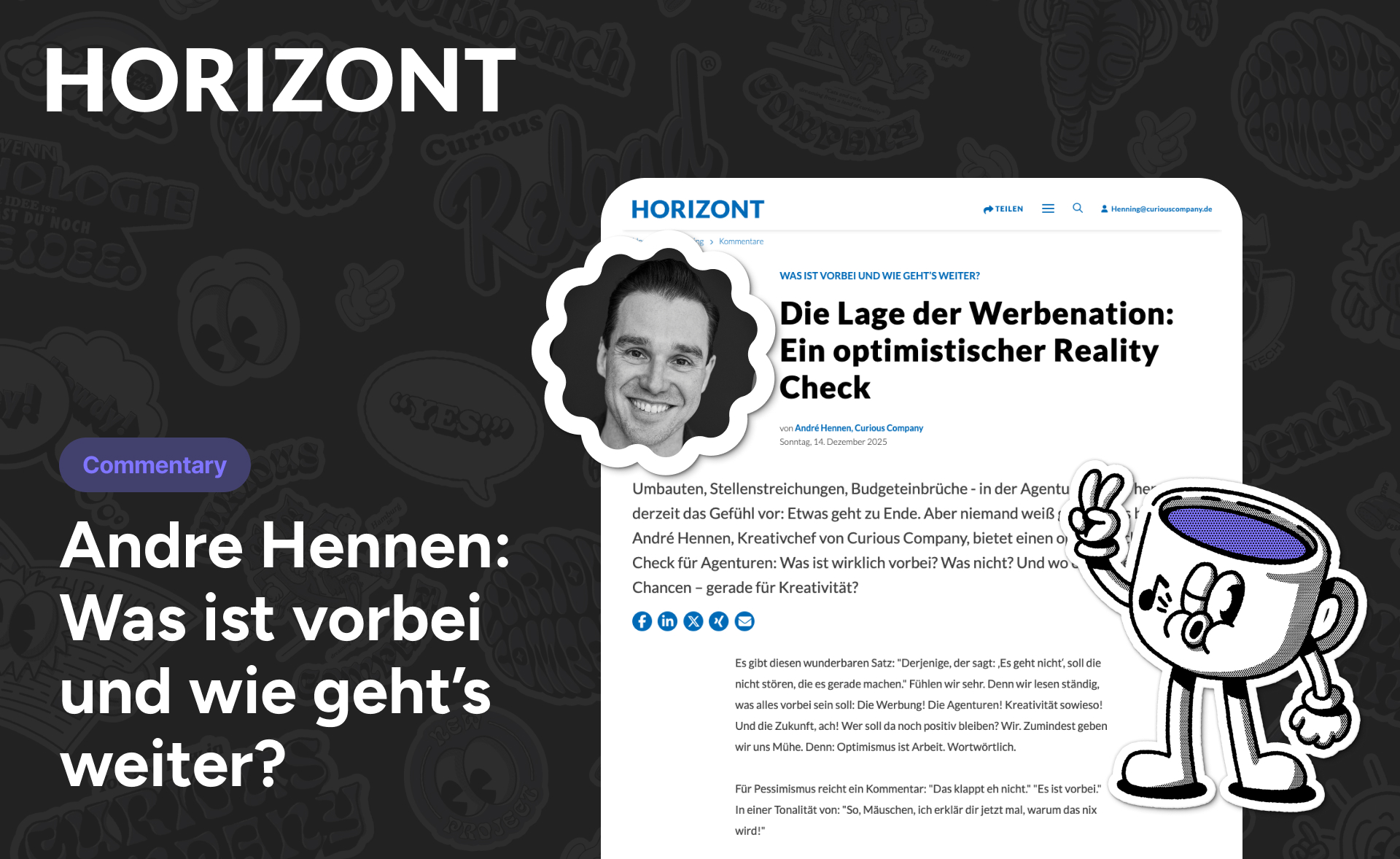
Link to the article on HORIZONT.
Agency layoffs, restructures, and budget cuts — it feels like something is ending in the industry. But what’s starting instead? André Hennen, Chief Creative Officer at Curious Company, offers an optimistic reality check: What’s really over? What’s not? And where are new creative opportunities opening up?
There’s this wonderful saying: “Those who say ‘it can’t be done’ shouldn’t interrupt the people who are doing it.” We really feel that. Because we constantly read that everything is supposedly over: advertising! agencies! creativity, especially! And the future—oh dear! How is anyone supposed to stay positive? We are. Or at least we try. Because optimism is work. Literally.
Pessimism only takes a comment: “That’ll never work.” “It’s over.” Said in a tone like: “Alright, sweetheart, let me explain to you why this won’t work.”
Anyone who wants to create something new has to get out of the comment section and into production—and prove that it can be done. Because creativity is still doing just fine; it’s just increasingly flowing into business models and products instead of “only” witty headlines (no offense to witty headlines). But let’s take this step by step:
What actually happened?
A brief bird’s-eye view before we get to the industry. Or, as Samuel Goldwyn put it: “We start with an earthquake and then gradually build up.”
1. Global level. Why is Germany’s economy doing so badly?
Germany’s prosperity rested on three pillars: China bought our combustion-engine cars, the U.S. paid for our security, and Russia sold us cheap gas.
Cut to today: China sells us electric cars, the U.S. no longer pays for our security, and Russia no longer sells us cheap gas. (Thanks to Robin Alexander for this summary.)
Anyone over the past 20 years who called for changing the system—national energy production through solar or wind, or good electric cars, for example—was, to put it cautiously, not exactly considered a visionary economic strategist. Add to that a shortage of skilled workers, weak digitalization (including AI), and poor digital education.
In short: welcome to the fourth year of an economic crisis—something that has never happened in postwar history.
2. Industry level. What is really over—and what isn’t?
A look back helps here, because the cause isn’t just budgets, crises, or AI.
For decades, there was the “15 percent agency commission.” A full-service model that financed media, creativity, and consulting in one package. In other words: creativity had a business model. Then everything was split up. Media went independent. Consulting too. Technology and platforms were added.
“Good creative work is becoming rarer—and therefore more valuable.”
(André Hennen)
3. Creativity remained—without a viable financing model.
Instead of thinking about new business models, creative agencies even began giving away their best ideas (award ideas and ranking tactics). If they had put just 5 percent of that creative output into the billing model, creativity would be thriving today. Proof of effectiveness (marketing ROI) was outsourced. Google or Meta now deliver these data in abundance—creating a deceptive sense of security (for example, the missing “proof of human”: were those millions of views actually 100 percent human? According to Cloudflare, around 50 percent of all internet traffic is already bots/AI). At the same time, fully automated AI campaign generators lure us with instant communication that is forgotten just as quickly as it is produced. Creativity by bots for bots.
So where do we go from here?
Communication will always be needed. More than ever. There is more work than ever before. Brands today have to stand out against AI slop, automated creativity, and overused ChatGPT strategies. This is exactly where I’m optimistic that talented people will be better than even the best AI for a very, very long time (which—this can’t be repeated often enough—doesn’t think, but merely simulates human behavior. OpenAI’s smartest advertising trick was writing “thinking” instead of “loading.”)
Communication will become more sustainable.
Instead of short campaign cycles, we’ll more often see products and platforms that reach people in a hyper-personalized way and retain them long term. Technology democratizes the craft—and in doing so increases the value of what machines cannot do: deviating from the norm. AI democratizes and accelerates production—and thereby raises the value and creates more time for ideas and strategy.
And it will be paid for differently. Performance models, licenses, SaaS, retainers, joint ventures—there are countless models that work better for both sides than the good old price list. Creativity suddenly has the chance to become a business model again—if we use it. And: good creative work is becoming rarer—and therefore more valuable.
There is a gigantic market for good ideas and outstanding creativity. And sometimes those ideas are hidden in the billing model.
So please, let’s keep going. And those who say, “It can’t be done”—they shouldn’t disturb us. We’re busy.
Next News