How to Evoke Genuine Emotions with Hyper-Personalization and AI
21. März 2025
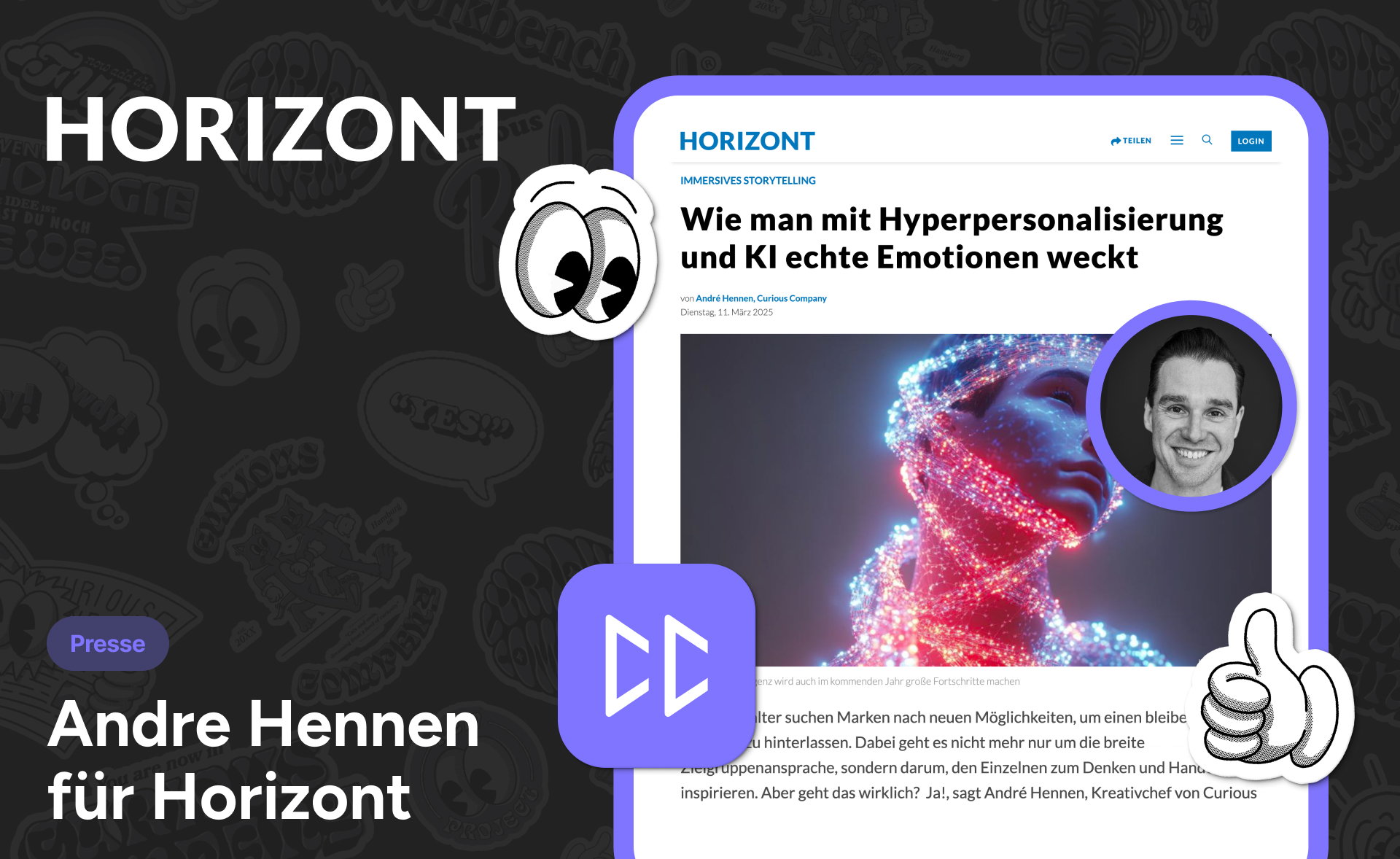
In the AI era, brands are seeking new ways to leave a lasting impression. It is no longer just about reaching broad target groups, but about inspiring individuals to think and act. But is that really possible? Yes!, says André Hennen, Creative Director at Curious Company. With immersive storytelling and hyper-personalized experiences that evoke strong emotions. In his guest article, he explores how this works and why brands benefit from it.
„90 percent of all online content (video, text, image, audio) will be synthetic (AI-generated) by 2026.“ Not me saying it, but the Europol Innovation Lab, which is hardly known for sensationalist news. 90 percent. This is no longer a trend or hype. This is a new reality. Yet, as fast as technology evolves, one thing remains surprisingly consistent: humans. They want emotional, relevant experiences and compelling stories. Tech and story – together they create something magical: Through immersive storytelling and relevant hyper-personalized experiences, we trigger deep emotional reactions – which in turn create strong (brand) impact.
Immersive storytelling with the „add-on“ hyper-personalization
20-second spots, motifs, influencers – many brands still deliver their stories linearly to the masses – for passive consumption or maybe just for a like. Most content is so interchangeable that we simply ignore the majority of it. That’s why theoretical visibility is no longer enough to stay in people’s minds.
But immersive storytelling achieves exactly that: Brands that actively involve people in their stories, create emotional connections, and turn their messages into experiences (humor! interaction! tasks!) anchor themselves on a completely different level in memory. And they do so by treating people not as mere viewers, but as individuals with an active role. We no longer broadcast – we invite them into an interactive (brand) story where they act and control events. Essential building blocks of immersive storytelling include:
● Character: Users are active protagonists of the story, with a clear sense of identity.
● Orientation: Users understand where they are and what options for action they have.
● Motivation: Users receive a clear, compelling goal that drives them to actively engage in the story.
The more authentic and relevant the experience is for me personally, the stronger my own emotional experience – and the potential brand impact. And this is where AI helps enormously: The magic word is hyper-personalization. And no, this is not about inserting a newsletter subscriber’s name into the first sentence. It means unique, tailor-made stories and user experiences that unfold according to individual needs, decisions, and interests.
An example: Users see a modified version of themselves (aged, as a child, as an elf, as an astronaut), interacting like a living character with them. This is the main character of the (brand) story and they engage in an AI-driven dialogue that triggers real actions and decisions. The medium is flexible: a large digital screen or a smartphone. Hyper-personalized AR or VR experiences even create greater immersion than „just“ a screen.
Is there (scientific) evidence for this?
I am a creative, so it is obvious to me that successful communication is always also good entertainment. However, I have long learned that people like evidence for the success of entertaining stories. So here it is. But don’t worry, I won’t bore you with dozens of studies proving the relevance of emotions for perception, decision-making, and brand impact (there are plenty). It’s also an old (but still valid) insight that brand recall and loyalty are stronger and more sustainable when users are actively involved. Active engagement with content promotes deeper processing, while playful approaches motivate and provide positive learning experiences. Game-based learning, anyone? – This continuously demonstrates the impact of immersive storytelling.
The more authentic and relevant the experience is for me personally, the stronger my own emotional experience – and the potential brand impact.A practical example is the „Meet Your Future Self“ experience for „Neue Leben“ and their Sparkassen partners. It uses multiple, partly new AI models to enable users to have an interactive conversation about their own aging. Internal analysis showed that the emotional impact was enormous and awareness about personal financial security was sustainably changed. This not only led to long average interaction times but also a significant increase in booked advisory appointments.
The Massachusetts Institute of Technology (MIT), one of the world’s leading universities, conducted a similar experiment a few months after our experience: Just a single session with one’s own „future self“ demonstrably strengthened the connection to this ideal older self and reduced negative emotions such as (future) anxiety. Even if the MIT experiment was not about advertising impact, it highlights the major influence of hyper-personalized immersive experiences. And – keyword creative – they are simply more fun.
How brands benefit
Immersive storytelling not only delivers more joy but also more business. Proven:
● More engagement: Interactive experiences extend the time users spend with a brand.
● Higher conversion rates: Direct interaction can significantly influence purchasing decisions.
● Measurability and optimization: Experiences can be continuously adapted and improved using AI.
How brands successfully implement immersive storytelling:
We often say „If technology is your idea, you don’t really have an idea yet.“ Therefore, we usually start with a problem.
● What should be achieved or solved? Only when the business strategy is advanced can an emotional story be developed and a technology be recommended in good conscience. Not the other way around.
● The story keeps business and tech together. As said at the beginning: People are still the same. We want good stories. We want to be able to act.
● The right technology works sustainably: The best experiences don’t end with a campaign period. They operate 24/7 and deliver the story as immersively as possible – ideally integrated seamlessly into daily life.
Welcome to the new reality. It’s going to be amazing!
Here in Germany, we are not exactly known for rushing enthusiastically when a new technology arrives. And yes, we have to be honest about which technologies are „ready now“ and which still need a few years. But immersive storytelling and AI-powered hyper-personalization already open up so many incredible possibilities that were unthinkable just a few years ago – this is one case where you can afford a little enthusiasm.
Next News