Curious Company: This is How the ADC Rookie Agency of the Year Ticks
27. Mai 2025
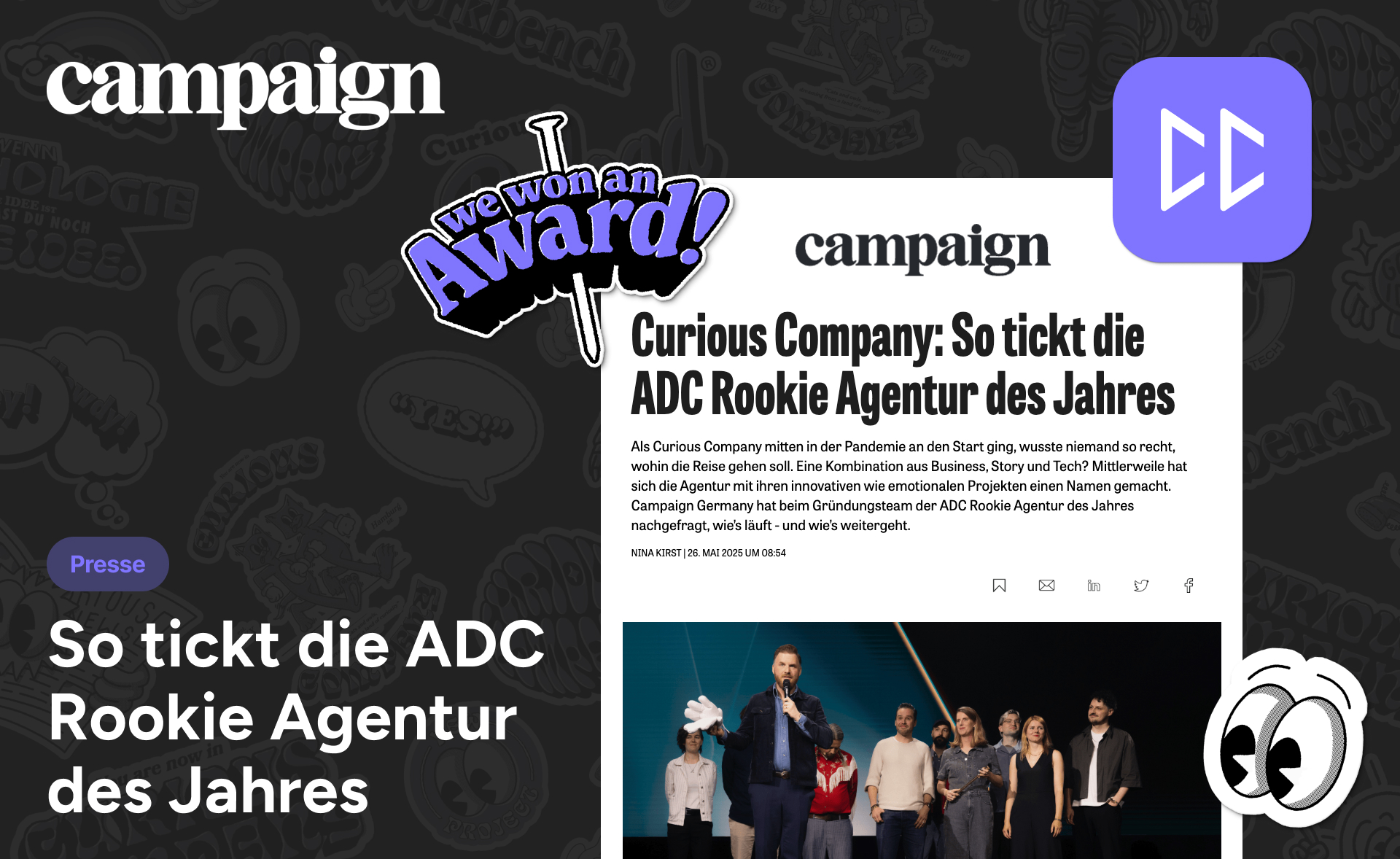
Link to the article at Campaign.
When Curious Company launched in the middle of the pandemic, no one really knew which direction it would take. A combination of Business, Story, and Tech? In the meantime, the agency has made a name for itself with its innovative and emotionally engaging projects. Campaign Germany asked the founding team of the ADC Rookie Agency of the Year how things are going – and what’s next.
One of the most emotional moments at this year’s ADC Awards came right at the start: when Philipp Feit from German Wahnsinn delivered the laudation for Curious Company and the team came on stage, a few eyes were visibly moist. This openness to emotion is also evident in the projects of the Hamburg agency, whether it’s the empathetic insight into the daily life of the homeless (“Unhome” with Gobanyo) or the tasteful staging of a “Future Self” (for Neue Leben).
Curious Company was founded by Henning Westerwelle, Julia Wübbe, and André Hennen in the summer of 2020. Westerwelle had previously left his position as managing director of the production company Infected, Wübbe had been Senior Digital Producer at Demodern, and Hennen worked as a freelance copywriter and author. The agency now has 12 full-time employees – all at senior or C-level. In addition, there is a freelancer pool for special disciplines or “crunch time.” Westerwelle manages Business and Strategy as CEO, Julia Wübbe handles operations and HR as COO, and Hennen oversees Storytelling and Branding as CCO. The management team is completed by CTO Dennis Gabriel, responsible for Tech Production and Code.
One of the agency’s first key clients was Globetrotter. The “VR Adventure” project ran from 2019 to 2022 and attracted many visitors to Globetrotter stores. The agency still works for this client. Over time, projects for Siemens, Neue Leben, and Europa Park followed. Currently, the agency also works for ZEIT für die Schule and Gustavo Gusto. Most recently, the team attracted attention with the Telekom campaign “Miniatur Warmland” in collaboration with Grabarz & Partner.
A special feature of almost all agency projects: they are still running. No short-term campaigns, but long-term digital marketing products – this has become Curious Company’s USP. In an interview with Campaign Germany, the founders reveal the secret of their success and their plans for the future.
Why has an agency like yours been missing until now? What’s your USP?
Henning Westerwelle: We see ourselves as a unique combination of strategy consulting, creative agency, and digital production that develops digitally sustainable products for brands and companies. All in-house. Our work often touches on gamification or entertainment – even in the serious B2B environment, where no one expects it.
Internally, we call this the “Business / Story / Tech Circle.” Nothing works without the other, and everything complements each other. This ensures the product or project lasts longer than a typical campaign period. Almost every project of ours (except trade show or event installations) is still live! They are being used right now, and we can track this in real-time on our own platform, Curi.OS.
Julia Wübbe: We realized that developing “digital marketing products” for our clients that remain alive has actually become a USP of our work. Nothing is launched just to be shut down after a two-month campaign period.
André Hennen: We break down a few silos in the industry: previously, there were creative agencies for storytelling, consultancies for business strategy, and digital productions for technology. Thankfully, those days are over. It only works together. We want people to truly engage with things – on an emotional level – and voluntarily! “Why should people actually care?” Sounds simple, but is often overlooked. This high creative competence and sustainability only works if we first define clear strategic and business goals with our clients, then implement productions, products, and campaigns through strong storytelling and relevant, carefully chosen technology.
You currently have 12 full-time employees. How big do you want to grow?
Wübbe: We consider the “company size = number of employees” metric outdated. And it’s not just about AI. Companies like Valve (Half-Life, Alyx, Steam Store) are estimated at $13 billion in revenue with only about 330 employees. OnlyFans, with $1 billion in revenue, has only 53 employees. Both examples are admittedly exaggerated from our perspective, but they show that it works differently today.
If we feel we need more people, we will hire. But at the moment, we can achieve everything with our seemingly small team. Finding the right people is not getting easier. At Curious, it’s more about a fundamental mindset than proficiency with a specific software. The people we work best with long-term all have immense curiosity and playfulness. Our clients benefit from that as much as our team. Mindset is more important than toolkit.
How are you organized to handle projects with just 12 people?
Westerwelle: One of our guiding principles is “Move it forward, Lock it down.” We like to make quick decisions and stick to them. This helps maintain focus and clarity on projects. When there are too many pots cooking, everyone loses oversight, especially for projects developing things that may not have existed before.
We therefore don’t have traditional meetings (many people, lots of time – unless we have something to celebrate). If a meeting lasts more than 25 minutes, it’s almost a warning signal: someone was unprepared, a decision is missing, or even the meeting’s goal is unclear. But that almost never happens.
Hennen: The only things that take longer are our internal inspiration formats. For example, “Curious Reload”: we show each other cool new things that aren’t directly related to our jobs. It works partially, but it’s always exciting! Some of the best stuff is now also posted on our Instagram. “Getting Smart with …” are real internal lectures, covering topics from ADHD to Figma deep dives to museum projects or professional experiences at Arte.
We also coordinate very quickly and flexibly via chat or audio. If someone needs something, is done with their area, or just wants to talk. We use Discord, a pro-gaming messenger, which provides quick drop-in channels for instant discussions. Like an open office, just remote.
Speaking of remote: Where do you work?
Wübbe: Remote, hybrid, or in our office in Ottensen – everything is possible. We work independently; how and where is up to each individual. Some are in Berlin, most in Hamburg, some have a 4-day week, others come almost every day, and some only on Monday, our shared office day. We realized we don’t need mandatory office presence; if necessary, we naturally meet. We’re all adults.
Also important: We are a team, not a family. True family (or friends) are important and should remain so, which is why we support mobile work, part-time, and sabbaticals.
How do you approach projects?
Wübbe: Our approach is Business / Story / Tech – in that order. The Circle starts with business strategy, which must be solid; otherwise, issues arise later. There must be a definable problem, openness to technology, and interest in a digital process. Then comes Story – translating sometimes dry content into an emotional, often immersive narrative. Users don’t just watch; they act. Without them, the story doesn’t progress, like in a book. Story also includes the entire visual world – everything must be cohesive. Every project has a distinct look. Tech is often discussed during the story process: what’s possible? What makes sense? We want things to run long-term, even on older devices. It’s not just about impressing festival juries; reality checks are necessary. That everything is still live shows the process works well so far.
Westerwelle: We are a curious team and always want to improve, because things don’t always work perfectly at first. That’s why retrospectives are crucial, both internally and with clients. We don’t work classically “agile,” but quick sprint processes help our projects.
What has proven effective: rapid prototyping! Making concepts and constructs visible – because “only seeing is believing.” Through click-dummies, sizzle reels, or tangible prototypes, we can quickly align expectations and iterate until the deadline is met.
What has been your absolute favorite project so far?
Westerwelle: You shouldn’t have a favorite child. They’re also too different to compare. Emotionally, “Unhome” wins. Our VR experience showing homelessness firsthand. The process started before founding the company – NGO projects take longer due to cross-financing. We were incredibly proud to premiere it at the ADC and show the experience to everyone.
Wübbe: From a business perspective, it’s “Welcome to Everyday.” As an internal learning platform for Siemens, it was so successful that we are developing the technology into its own product and business model called “Curious Engine.”
Hennen: The “Future Self” for Neue Leben was an amazing transformation for the client. The previous campaign was just cardboard cutouts. More digital transformation is hard to top. For ZEIT für die Schule, we develop learning games, for Europa-Park entertaining AR extensions. We love them all.
Do you have role models – people or agencies?
Westerwelle: People with clear goals and values like our partners at Gobanyo impress us. Highly creative and technical workers like our friends at Elastique constantly push us to think further outside the box.
Wübbe: In terms of processes, employer branding, and communication, we often get inspiration from the startup scene, regardless of the industry. We are a “speedboat” and always watch others moving fast in their processes and decisions.
Hennen: I also draw energy from direct competitors. Seeing what Artificial Rome, Elastique, or German Wahnsinn (not to mention international examples) do. The great thing is: we are all friends and can ask each other for advice anytime (and we do). It only makes us better.
What have been the biggest challenges at Curious Company?
Westerwelle: We founded in summer 2020. Starting a company in lockdown was bold. The polycrises of the 2020s repeatedly challenge growth and development, but in these uncertain times, there are also opportunities and hidden elements for curious minds.
What are your goals for the next few years? Where do you want to be in 5-10 years?
Wübbe: We want to keep building stages for curiosity and digital sustainability and develop relevant projects and products that last and have impact. If we achieve that, we are very satisfied.
Which clients would you like to work with?
Hennen: Anyone interested in extraordinary creations that bring joy and last long. Coincidentally, that matches exactly the clients we already have. But maybe there’s another one. We always look for clients as passionate about digital, innovative story- and gaming-driven approaches as we are – that’s when great ideas, campaigns, and products emerge. Erobique once sang: “I owe life the sparkle in my eyes.” That’s from the song “Wann strahlst du?” (the full lyrics are fantastic). We look for people with that sparkle in their eyes. Clients included.
Where do you get your inspiration?
Westerwelle: Most inspiration is always in front of you; you just need to read and learn to understand it. If we don’t understand something, we learn as best as we can. Another guiding principle: the curious never stop. Ideas come from everywhere, in the shower, on a walk, or even from a TikTok reel.
How important are awards to you?
Hennen: We use awards as a quality check. A jury is the toughest form of feedback, often stricter than clients or consumers. It would be a shame not to use that. Our goal is that our everyday work, in addition to achieving measurable results for clients, also receives recognition from a professional jury. When that happens, we go all out. Being named Rookie Agency 2025 is, of course, complete madness.
Next News